
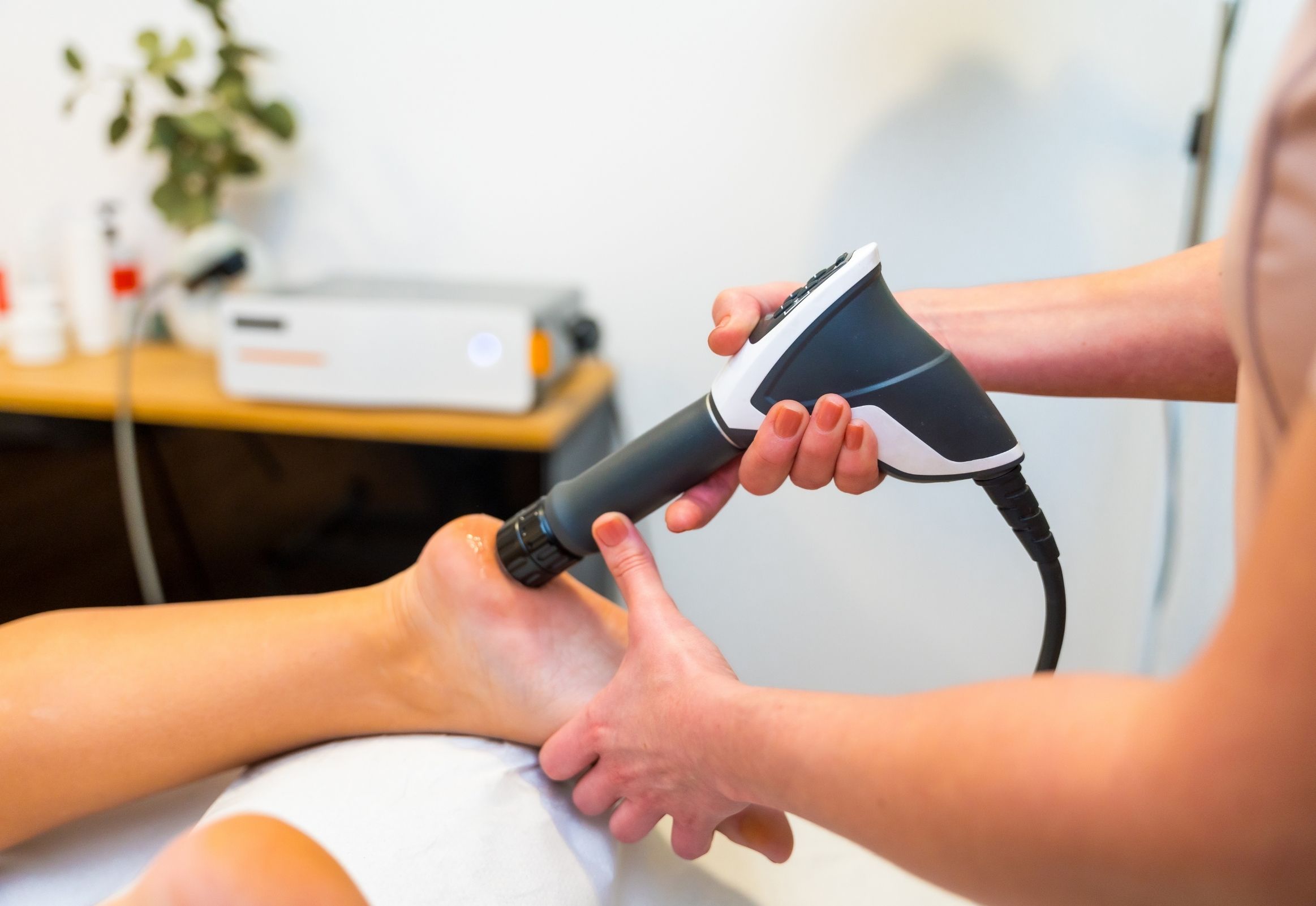
SoftWave therapy is a brand of acoustic wave therapy that uses a specific type of shockwave device to treat pain and stimulate healing in muscles, tendons, ligaments, and joints. It is a form of extracorporeal shockwave therapy, meaning the energy is delivered from outside the body through the skin, without needles or incisions. What sets SoftWave apart is how its waves are produced: its devices use an electrohydraulic generator, in which a high-voltage spark under water creates a true acoustic shockwave that is then transmitted into the tissue through a handheld applicator. The term “shockwave therapy” is often used loosely to describe two different technologies: focused shockwaves, which are true shockwaves generated electrohydraulically, electromagnetically, or piezoelectrically and can deliver energy deep into tissue; and radial pressure waves, which are produced mechanically by a projectile striking the applicator, deliver their highest energy at the skin surface, and are not true shockwaves in the strict physical sense. Many clinics that advertise “shockwave” use radial pressure wave devices. SoftWave devices are FDA-cleared for relief of minor muscle aches and pains, a temporary increase in local blood circulation, and activation of connective tissue. Both technologies have research support for conditions such as plantar fasciitis and tendon problems.
Shockwave therapy uses pulses of acoustic energy to treat painful musculoskeletal conditions, particularly chronic tendon problems, plantar fasciitis, and some joint and muscle conditions. There are two main categories. Focused shockwaves are true shockwaves with a very rapid rise in pressure and high peak pressure; they are produced by electrohydraulic, electromagnetic, or piezoelectric generators and can concentrate energy several centimeters below the skin. Radial pressure waves are produced by compressed air driving a projectile into the applicator; their energy is highest at the skin and spreads outward, their peak pressure is much lower, and physicists do not consider them true shockwaves. SoftWave devices generate their waves electrohydraulically, using a high-voltage spark under water, and transmit them through a water-filled membrane and applicator. The FDA has cleared the SoftWave OrthoGold 100 device for relief of minor muscle aches and pains, temporary increase in local blood circulation, and activation of connective tissue, as well as for certain burn treatment. A systematic review of shockwave trials concluded that shockwave therapy is effective and safe for tendon and other musculoskeletal conditions, recommended that the labels “low-energy” and “high-energy” be dropped as inaccurate, and found no scientific evidence that either focused or radial waves produce better outcomes. Treatment is non-invasive, typically involves a short series of sessions, and works best as part of a plan that includes rehabilitation.
Shockwaves are short, high-energy pulses of sound that travel through tissue. In medicine, they were first used decades ago to break up kidney stones without surgery. Researchers later found that lower-intensity acoustic waves applied to muscles, tendons, and bones could reduce pain and stimulate healing, which led to their use in orthopedics and sports medicine.
When acoustic waves pass through tissue, they create rapid changes in pressure that are thought to trigger a biological response. Proposed effects include increased blood flow and formation of new small blood vessels, release of growth factors, stimulation of tissue repair, breakdown of calcium deposits in tendons, and reduced activity of pain-transmitting nerve fibers. This process, in which a mechanical stimulus produces a biological healing response, is sometimes called mechanotransduction.
Understanding this explains why shockwave therapy is used mainly for chronic conditions that have stalled in the healing process, such as long-standing tendon pain or plantar fasciitis, rather than for acute injuries or problems that need surgical repair.
How they are produced. Focused shockwaves are produced inside a water-filled applicator by one of three methods: an electrical spark (electrohydraulic), an electromagnetic coil, or piezoelectric crystals. The waves are then directed into the body. Radial pressure waves are produced mechanically: compressed air drives a small projectile into the tip of the applicator, and the impact sends a pressure wave into the skin.
Where the energy goes. Focused shockwaves concentrate their energy in a target zone below the skin, often several centimeters deep. Radial pressure waves deliver their highest energy at the skin surface, and the energy weakens as it spreads outward into deeper tissue. Radial devices are therefore often described as better suited for treating larger, more superficial areas.
Physical characteristics. True shockwaves have an extremely rapid rise in pressure and a high peak pressure. Radial pressure waves rise more slowly and have a much lower peak pressure. For this reason, physicists and shockwave researchers consider radial pressure waves a distinct technology rather than true shockwaves, even though both are commonly marketed as “shockwave therapy.”
What this means for patients. Because both technologies are called shockwave therapy, it is reasonable to ask which type of device a clinic uses. That said, the type of device is only one factor. Correct diagnosis, appropriate energy settings, the number of sessions, and combining treatment with rehabilitation all affect results.
SoftWave is a brand name for acoustic wave devices made by SoftWave Tissue Regeneration Technologies. FDA records describe its OrthoGold 100 device as an electrohydraulic system: a high-voltage discharge across a spark gap under water generates the acoustic wave, which travels through a water-filled membrane to a handheld applicator and into the tissue through a silicone membrane and ultrasound gel. This places SoftWave in the true shockwave category rather than the radial pressure wave category.
The FDA has cleared the OrthoGold 100 for activation of connective tissue, relief of minor muscle aches and pains, and a temporary increase in local blood circulation. The device has also been cleared for use with standard care in the treatment of superficial partial-thickness, second-degree burns in adults.
Published research comparing SoftWave devices directly with other shockwave devices is limited. Most of the clinical evidence for shockwave therapy comes from studies of a variety of focused and radial devices, so results from those studies should not be assumed to apply equally to every brand or setting.
A systematic review of randomized trials of shockwave therapy for orthopedic conditions, including calcific shoulder tendinopathy, plantar fasciitis, Achilles tendinopathy, tennis elbow, and shoulder pain, concluded that shockwave therapy is effective and safe for tendon and other musculoskeletal conditions. Results varied across individual trials, with some showing significant benefit over placebo or comparison treatments and others not.
Before treatment, the area is assessed to confirm the diagnosis and identify the target. Gel is applied to the skin, and the applicator is placed over the painful area. Patients typically feel rhythmic tapping or pulsing, and the treated area may be tender during the session, especially over irritated tendons. Sessions are usually short, and no anesthesia, needles, or downtime are required. Most treatment plans involve a series of sessions over several weeks, and improvement often builds gradually over the following weeks to months as the tissue responds.
If you have chronic tendon pain, plantar fasciitis, calcific shoulder tendinopathy, tennis elbow, or another persistent musculoskeletal problem that has not improved with rest, exercise, or other conservative care, an evaluation can help determine whether shockwave therapy is a reasonable option.
At our practice, Dr. A. Dianne Obayan evaluates each patient to identify the specific source of pain before recommending treatment. When shockwave therapy is appropriate, it is typically combined with rehabilitation and, when indicated, other regenerative treatments. We explain what the treatment can and cannot do, how progress will be measured, and how it fits into your overall plan.
Shockwave therapy is generally not used over areas with an active infection, a tumor, or open growth plates in children; over the abdomen or low back during pregnancy; directly over blood vessels, or the lungs; or in people with bleeding disorders or those taking certain blood thinners, without careful assessment. It is not a substitute for surgery when there is a complete tendon tear, a fracture, or a problem that needs surgical repair. Be cautious about programs that promise a cure or require a large prepaid package before any improvement has been assessed.
Your safety comes first. Seek urgent medical care for sudden severe pain or swelling, a joint that becomes hot, red, and swollen with fever, inability to bear weight after an injury, or new numbness or weakness in an arm or leg. These symptoms need evaluation rather than shockwave treatment.
Shockwave therapy is generally safe when performed with appropriate settings. Common, temporary side effects include soreness, redness, mild swelling, and small bruises or areas of tiny skin bleeding at the treatment site. Serious complications are uncommon. Report any severe or worsening pain, numbness, or skin changes after treatment.
Some providers recommend avoiding anti-inflammatory medications around shockwave sessions, but you should not stop or change any prescribed medication without medical guidance. If you take blood-thinning medication or have a bleeding disorder, tell your provider before treatment. We work collaboratively with your existing healthcare team to ensure safe, coordinated care.
Ready to talk it through? After you’ve reviewed more about our ANEW approach, the best first step is to schedule a consultation so we can understand your symptoms, goals, medical history, and prior treatment experience.
During your consultation process, we may review imaging, discuss prior care, evaluate your movement and function, and determine whether you may be a candidate for ANEW’s non-surgical restoration options.
This educational content is not a substitute for personal medical care.
Medically Reviewed By: Dr. A. Dianne Obayan, M.D. P.T.
Let's build your path to recovery - together.

Advanced regenerative care for lasting results.
ANEW Regenerative Medicine Specialists
28544 Orchard Lake Rd,
Farmington Hills, MI 48334
Tel: 248-861-2639
Email: care@anewregen.com