

An MRI report that says "torn meniscus" can sound like a surgical diagnosis. But meniscus tears are not all the same, and the tear seen on the scan is not always the only, or even the primary, source of knee pain. At ANEW, we match the imaging to your symptoms, examine the entire knee, and build a meniscus-preserving plan whenever that is medically appropriate.
You may have felt a twist, pop, or sudden pain during sports, exercise, or an everyday movement. Or the discomfort may have developed gradually, with no memorable injury at all. Now the knee hurts with squatting, pivoting, stairs, or getting out of a chair. It may swell, catch, or feel unreliable. Perhaps an MRI found a meniscus tear and you were told that arthroscopic surgery is the next step.
Sometimes surgery is appropriate, particularly when a displaced tear blocks motion, an acute tear is repairable, or the knee has major instability. But many degenerative and non-obstructive tears can be treated without immediately removing meniscus tissue. The first question should not simply be, "Is there a tear?" It should be, "What type of tear is present, is it actually causing the symptoms, and what approach best protects the knee over time?"
Each knee has two menisci: one on the inner side and one on the outer side. These strong, curved pads of fibrocartilage sit between the thighbone and shinbone. They help distribute load, absorb shock, improve joint stability, protect the articular cartilage, and guide smooth movement.
Because the meniscus performs several jobs at once, preserving as much healthy, functional tissue as possible is important. When a portion is removed, the remaining knee has less surface area to distribute force, which can increase stress on the joint over time.
An acute tear usually occurs during a specific event - often a pivot, deep bend, sudden stop, direct impact, or awkward landing. These tears are more common in athletes and active patients, but they can occur during everyday activity. The pattern, location, size, displacement, and associated injuries determine whether the tear may respond to rehabilitation, should be repaired, or requires more urgent surgical evaluation.
Degenerative tears develop as the meniscus gradually becomes less resilient. They may appear after a minor twist or without a clear injury. They are common in middle-aged and older adults and frequently occur alongside knee osteoarthritis. In this setting, the tear may be one part of a broader joint problem rather than a single structure that can be "fixed" by trimming it.
Terms such as horizontal, radial, complex, flap, bucket-handle, root, and displaced tear describe different patterns. Some remain stable and can be managed without surgery. Others reduce the meniscus's ability to distribute load or create a mechanical block. A meniscus root tear, a displaced bucket-handle tear, or a tear associated with major ligament instability deserves timely orthopedic assessment because delaying appropriate treatment may affect the joint.
Catching is not always the same as a truly locked knee.
A knee that clicks or briefly catches may still move through its full range. A truly locked knee has a persistent mechanical block that prevents full bending or straightening. True locking, major instability, or rapidly increasing swelling should be evaluated promptly.
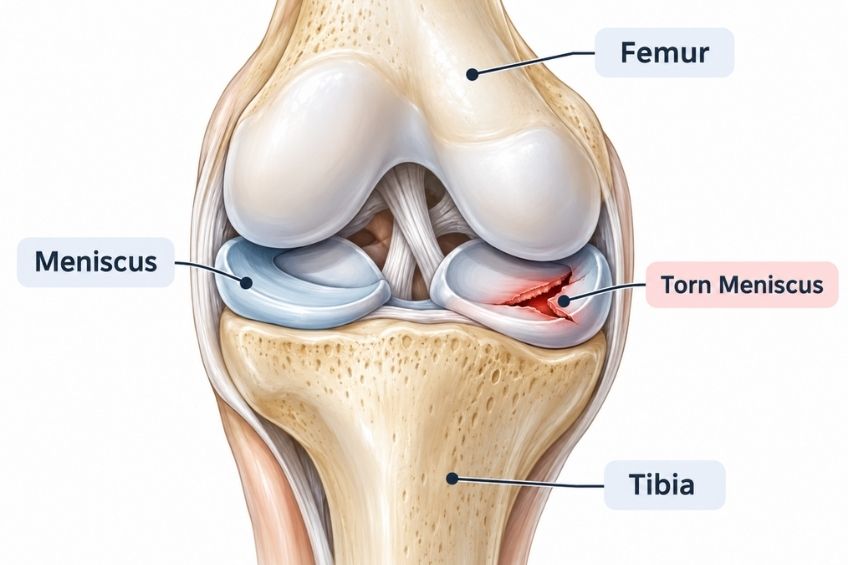
Meniscus tears can be visible on MRI in people who have little or no knee pain. This is especially common with degenerative tears and arthritis. At the same time, pain that appears to come from the meniscus may actually be driven by cartilage loss, bone stress, joint inflammation, tendon problems, ligament instability, kneecap mechanics, or weakness around the knee.
For that reason, ANEW does not recommend treatment based on the wording of the MRI report alone. The location and pattern of the tear must match your symptoms, examination, movement limitations, and the rest of the knee.
The meniscus and the joint surfaces work together. A degenerative meniscus tear may develop because the knee is already changing from osteoarthritis. Conversely, a traumatic tear or loss of functional meniscus tissue can increase the load on the cartilage and contribute to future joint degeneration.
When arthritis and a meniscus tear occur together, simply removing the torn portion may not address the main pain generator. The treatment plan must consider the joint surfaces, alignment, swelling, muscle strength, stability, gait, and the patient's functional goals, not just the tear.
Every recommendation begins with determining what kind of tear you have and whether it explains the problem you are experiencing.

Define the tear, determine whether it matches your symptoms, evaluate arthritis and instability, and identify any urgent surgical features.

Restore motion, control swelling, strengthen the hip and knee, improve mechanics, and progressively reload the meniscus.

Consider an image-guided orthobiologic procedure for a carefully selected case, or arrange surgical evaluation when repair or another operation is the better path.
For many degenerative, stable, or non-obstructive tears, the first-line plan focuses on reducing irritation while restoring the strength and control needed to protect the knee. Treatment may include activity and load modification, progressive exercise, hip and quadriceps strengthening, balance and neuromuscular training, movement retraining, treatment of coexisting arthritis, and scheduled reassessment.
The goal is not indefinite rest. It is to keep the knee moving safely, rebuild its capacity, and gradually return to the activities that matter to you.
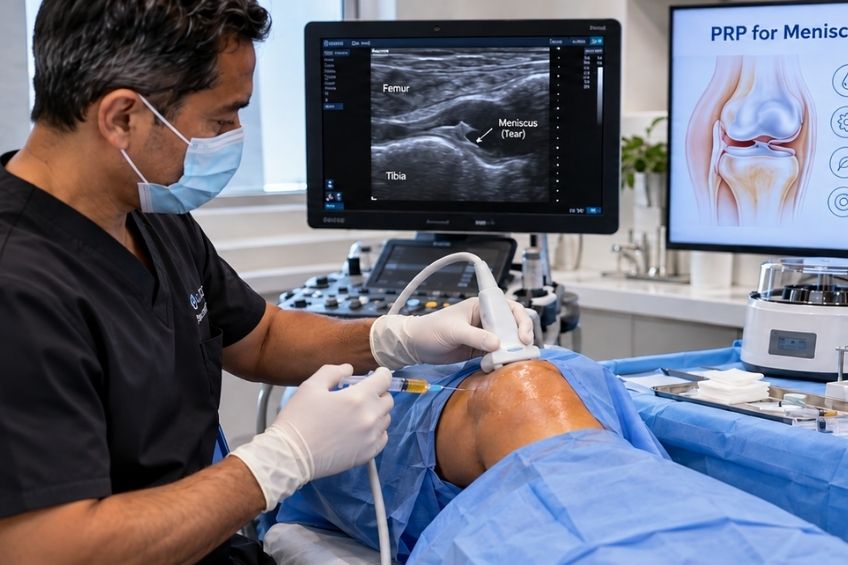
Platelet-rich plasma or another autologous orthobiologic procedure may be considered in selected patients with chronic or degenerative meniscal pathology, particularly when symptoms persist despite appropriate rehabilitation or when arthritis and other treatable knee structures are also involved. The procedure may target the joint, the meniscus, or associated structures depending on the diagnosis.
Evidence for non-surgical PRP treatment of meniscus tears is still developing. Some studies report improvements in pain and function, but imaging results, protocols, and study quality vary. PRP cannot be promised to heal every tear, restore a missing piece of meniscus, or eliminate the possibility of surgery.
Surgical evaluation may be the best next step when a tear is displaced and blocks motion, an acute tear has repair potential, a root tear threatens meniscal function, the knee has significant instability, or symptoms remain unacceptable despite an appropriate non-surgical program.
When surgery is indicated, preserving or repairing functional meniscus tissue is generally preferable to removing more tissue than necessary. A repair requires a longer and more protected recovery than a simple trimming procedure, but it may better protect the knee when the tear is repairable.
For many patients with degenerative, non-obstructive meniscus tears, high-quality exercise-based physical therapy can provide knee function comparable to arthroscopic partial meniscectomy over long-term follow-up. This is especially relevant when there is no true mechanical block and the tear occurs alongside arthritis.
That does not mean surgery is never useful. It means the decision should be based on tear pattern, mechanical symptoms, stability, arthritis severity, response to rehabilitation, and your goals, not simply the presence of a tear on MRI.
Your plan may include one or more of the following. The purpose is to address the problems identified during the evaluation, not to use every available service.
Some patients need urgent, surgical, rheumatologic, or other specialist evaluation rather than an ANEW restoration program. Examples may include a recent fracture, suspected infection, a hot and acutely swollen joint, severe or rapidly progressive deformity, a completely unstable ligament injury, a true locked knee, or symptoms suggesting an inflammatory or systemic disease. We will be candid when another pathway is more appropriate.
The goal is clarity, not pressure.
You should leave the consultation understanding what the tear means, what else may be contributing to the pain, and why the recommended next step fits your knee.
Advanced regenerative and functional-restoration services at ANEW are self-pay treatments. Before treatment begins, our team will explain the recommended plan, what is included, the expected timeline, and the associated cost. Payment and outside financing options may be available, and HSA or FSA funds may be usable when permitted by your plan.
Treatment recommendations are based on medical appropriateness and candidacy, not financing eligibility. Coverage for imaging, conservative care, or surgical services depends on the provider, location, and insurance plan.
Dr. Dianne Obayan is uniquely trained as both a board-certified physician and a licensed physical therapist. She is board-certified in Physical Medicine and Rehabilitation, Pain Medicine, and Sports Medicine, giving her an exceptional understanding of how the joints, muscles, and nervous system work together. This combined expertise allows her to evaluate knee arthritis from both a medical and functional perspective and develop comprehensive, non-surgical treatment plans designed to relieve pain, restore movement, strengthen the supporting muscles, and help patients preserve their natural joints.
That combination is especially valuable for meniscus problems, where the correct plan may range from progressive rehabilitation to a precisely targeted procedure or timely surgical referral. The objective is not to avoid surgery at all costs. It is to preserve the meniscus and the natural knee whenever doing so is safe, evidence-informed, and likely to improve function.
This page is for general education and does not replace an individualized medical evaluation. Results vary, and no treatment can guarantee meniscus healing, pain relief, return to activity, or avoidance of surgery. Evidence for non-surgical orthobiologic treatment of meniscus tears is still developing. Some advanced regenerative therapies are not FDA-approved to treat orthopedic conditions; candidacy, evidence, alternatives, and limitations are reviewed before treatment.
Let's build your path to recovery - together.

Advanced regenerative care for lasting results.
ANEW Regenerative Medicine Specialists
28544 Orchard Lake Rd,
Farmington Hills, MI 48334
Tel: 248-861-2639
Email: care@anewregen.com