
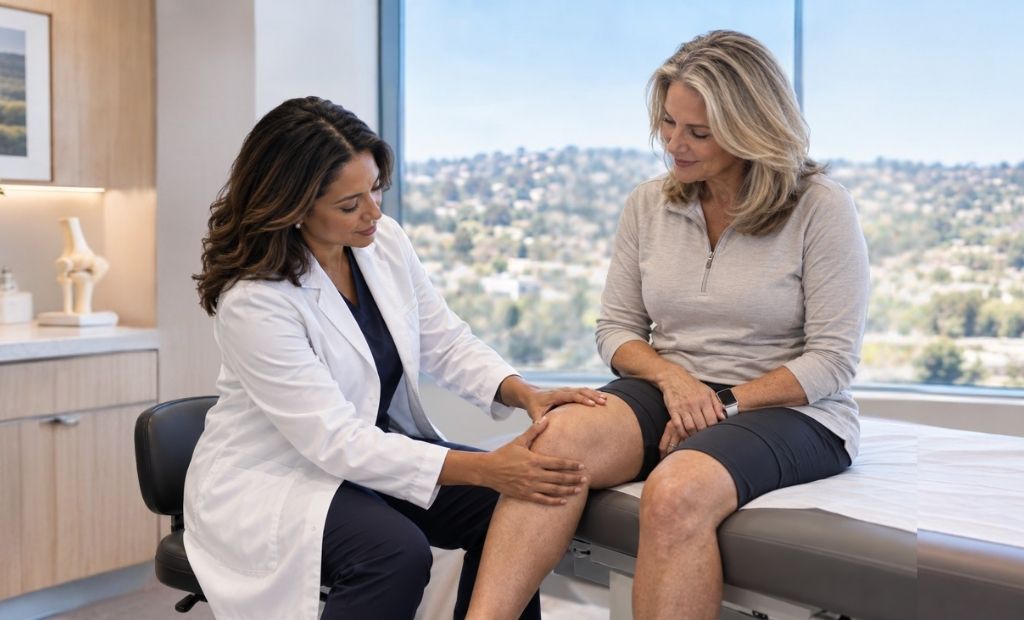
Knee pain can make walking, stairs, exercise, travel, and even getting out of a chair feel harder than they should. At ANEW, we look beyond a single X-ray, MRI finding, or injection to build a physician-led plan designed to reduce pain, restore strength, improve movement, and preserve your natural knee whenever appropriate.
Knee arthritis rarely announces itself all at once. It may begin as stiffness after sitting, an ache after a long day, or discomfort with stairs. Over time, you may notice that you are walking less, avoiding exercise, planning around pain, or losing confidence in the knee because it feels weak, swollen, or unpredictable.
You may already have tried physical therapy, braces, anti-inflammatory medications, cortisone injections, hyaluronic acid injections, or periods of rest. Perhaps these helped temporarily, but the pain returned. Or you may have been told that your arthritis is “bone-on-bone” and that knee replacement is the next step.
A surgical opinion may be appropriate for some patients. But before making that decision, many people want a careful review of the non-surgical and joint-preserving options that may still be available. That is the purpose of the ANEW knee evaluation.
Arthritis is a broad term for conditions that affect a joint. Osteoarthritis is the most common form and the primary type discussed on this page. It develops through changes involving the cartilage, bone, joint lining, and other tissues that help the knee move smoothly. Previous injuries, age, genetics, body weight, repetitive loading, muscle weakness, and movement mechanics may all influence how symptoms develop and progress.
Other forms of arthritis—including rheumatoid arthritis, gout, and other inflammatory conditions—require a different evaluation and may need coordination with a rheumatologist or another specialist. You do not need to know which type you have before contacting us. Determining what is actually causing your symptoms is part of the evaluation.
Arthritis is common, but it is not the only source of knee pain. Meniscus tears, ligament injuries, tendon disorders, kneecap tracking problems, cartilage injuries, bursitis, muscle weakness, and pain referred from the hip or spine can produce overlapping symptoms. Many patients have more than one contributor at the same time.
That is why we do not treat an imaging report in isolation. An MRI may show a meniscus tear or cartilage loss, but the finding must match your symptoms, physical examination, movement pattern, and functional limitations before it becomes the focus of treatment.
Related knee pages
Meniscus Tears | Knee Ligament, Tendon and Cartilage Injuries | Bone on Bone Knee Arthritis
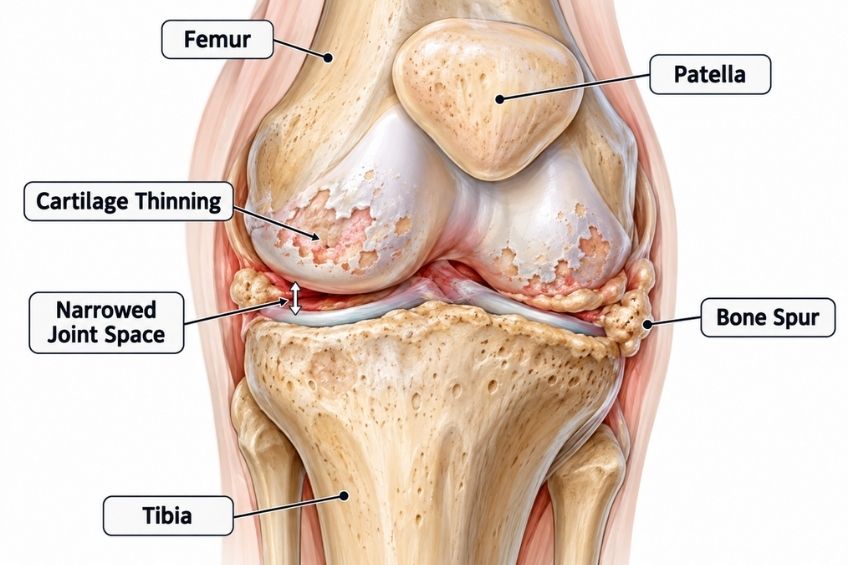
A painful knee is a working system—not a single piece of cartilage. The joint surfaces, menisci, ligaments, tendons, muscles, alignment, balance, and movement patterns all affect how force travels through the knee. When one part becomes weak or injured, other structures may absorb more stress.
This is the foundation of ANEW’s Joint–Muscle–System approach:
For this reason, we do not offer an isolated injection as though it were a complete knee-restoration plan. When a procedure is appropriate, we also consider the strength, mechanics, rehabilitation, and follow-up needed to protect the result.
Every treatment recommendation begins with a diagnosis and a candidacy assessment. Your evaluation may include:
When an injection or orthobiologic procedure is recommended, image guidance is used when appropriate to improve accuracy and place treatment at the intended structure rather than relying on surface landmarks alone.

Clarify the diagnosis, review imaging, examine movement and strength, and define your goals.

Improve the environment around the knee through rehabilitation, muscle restoration, supportive therapies, and movement retraining.

Use PRP or another appropriate orthobiologic procedure when the expected benefit justifies the treatment.
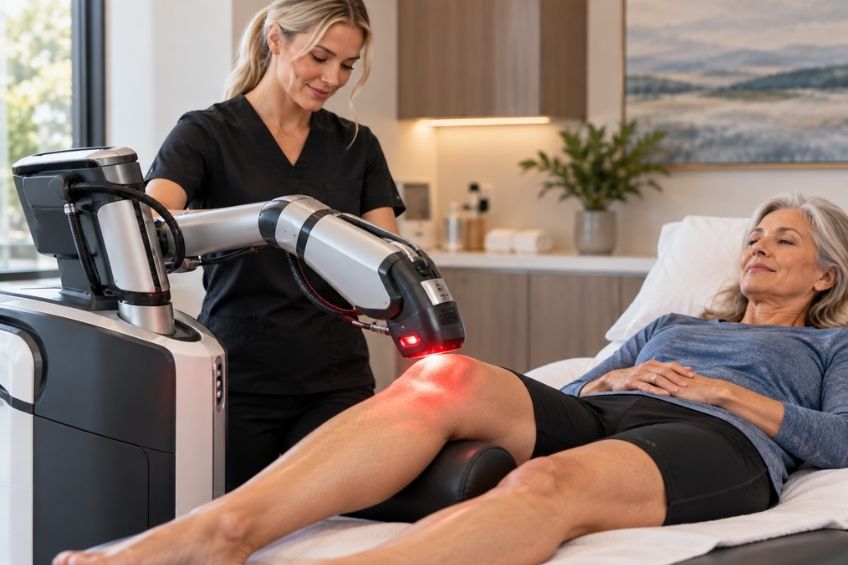
This pathway is designed for patients who may benefit from reducing irritation, restoring strength, improving mechanics, and supporting tissue recovery without beginning with an injection. Depending on your findings, the plan may include targeted rehabilitation, bracing, activity and load modification, Shockwave therapy, MLS laser therapy, muscle-restoration treatment, and structured reassessment.
For appropriate candidates, platelet-rich plasma may be used as part of a broader plan rather than as a stand-alone shot. PRP is prepared from your own blood and contains a concentrated portion of platelets and signaling proteins. It may be placed into the knee joint or selected supporting structures under image guidance, depending on the diagnosis. Rehabilitation, muscle support, and follow-up are coordinated around the procedure.
Patients with more advanced osteoarthritis or more complex joint involvement may be evaluated for advanced autologous orthobiologic approaches, which can include bone marrow aspirate concentrate, microfragmented adipose tissue, intraosseous procedures, or a combined strategy when medically appropriate. These procedures are not appropriate for everyone, do not recreate a normal joint, and cannot guarantee that surgery will be avoided. The recommendation depends on a detailed review of your joint, health, goals, evidence, alternatives, and expected limitations.
Your recommendation may include one or more of the following. The goal is not to use every treatment; it is to select the smallest combination likely to address the problems identified during your evaluation.
Because evidence and response vary by condition and patient, no treatment is recommended solely because it is newer, more expensive, or more advanced.
You may be a good candidate for an ANEW knee evaluation if you:
Some patients need urgent, surgical, rheumatologic, or other specialist evaluation rather than an ANEW restoration program. Examples may include a recent fracture, suspected infection, a hot and acutely swollen joint, severe or rapidly progressive deformity, a completely unstable ligament injury, a true locked knee, or symptoms suggesting an inflammatory or systemic disease. We will be candid when another pathway is more appropriate.
Joint preservation is not the right answer for every knee. Knee replacement may be appropriate when structural damage is severe, pain and loss of function remain unacceptable despite reasonable non-surgical care, or the likelihood of meaningful benefit from a restoration program is low.
Our goal is not to oppose surgery. It is to help you make a well-informed decision. When joint-preserving care is reasonable, we will explain the options and limitations. When surgery is the better path, we will tell you that as well.
No pressure. No predetermined procedure.
The purpose of the consultation is to determine what is appropriate—not to fit every patient into the same treatment or sell the most advanced option.
Advanced regenerative and functional-restoration services at ANEW are self-pay treatments. Before treatment begins, our team will explain the recommended program, what is included, the expected timeline, and the associated cost. Payment and outside financing options may be available, and HSA or FSA funds may be usable when permitted by your plan.
Treatment recommendations are based on medical appropriateness and candidacy—not on financing eligibility. You will have the information needed to consider the clinical and financial aspects of care before making a decision.
Dr. Dianne Obayan is uniquely trained as both a board-certified physician and a licensed physical therapist. She is board-certified in Physical Medicine and Rehabilitation, Pain Medicine, and Sports Medicine, giving her an exceptional understanding of how the joints, muscles, and nervous system work together. This combined expertise allows her to evaluate knee arthritis from both a medical and functional perspective and develop comprehensive, non-surgical treatment plans designed to relieve pain, restore movement, strengthen the supporting muscles, and help patients preserve their natural joints.
Her philosophy is straightforward: before recommending a procedure, identify what is driving the pain; before focusing on an MRI, understand how the knee functions; and before assuming surgery is the only answer, determine whether an appropriate joint-preservation pathway remains.
This page is for general education and does not replace an individualized medical evaluation. Results vary, and no treatment can guarantee pain relief, tissue regeneration, avoidance of surgery, or a specific recovery timeline. Some advanced orthobiologic procedures are not FDA-approved to treat knee osteoarthritis; candidacy, evidence, alternatives, and limitations are reviewed before treatment.
Let's build your path to recovery - together.

Advanced regenerative care for lasting results.
ANEW Regenerative Medicine Specialists
28544 Orchard Lake Rd,
Farmington Hills, MI 48334
Tel: 248-861-2639
Email: care@anewregen.com