

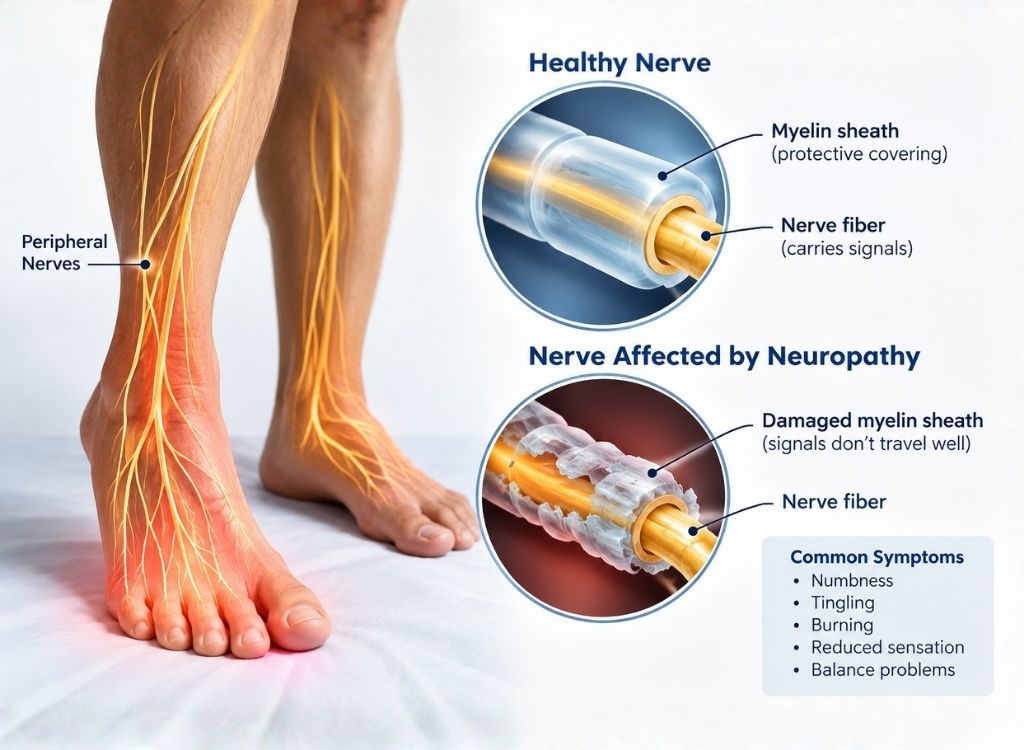
Neuropathy can change the way you move through life. Some patients describe burning, tingling, pins and needles, numbness, coldness, tightness, heaviness, or the feeling that they are walking with socks on even when barefoot. Others notice that they are less steady on their feet, more cautious on stairs, or afraid of falling.
For many people, neuropathy is not just uncomfortable. It affects sleep, walking, balance, exercise, confidence, and independence.
Many patients with neuropathy are offered medication to reduce nerve pain. Medication may help some patients, but it does not always address the full problem. Neuropathy may involve nerve irritation, reduced circulation, metabolic dysfunction, inflammation, poor balance, muscle weakness, gait changes, spine-related nerve compression, or focal nerve entrapment.
At ANEW Regenerative Medicine Specialists, we take a physician-led, restorative approach to neuropathy and nerve-related symptoms. Our goal is to understand what may be contributing to your symptoms, support nerve health when possible, improve function, and help you move with greater confidence.
Peripheral neuropathy means that nerves outside the brain and spinal cord are not functioning normally. Diabetes and prediabetes are common contributors, but they are not the only causes.
Neuropathy or nerve-related symptoms may be associated with diabetes, prediabetes, metabolic syndrome, vitamin deficiencies, thyroid disease, kidney disease, chemotherapy, alcohol-related nerve injury, autoimmune or inflammatory conditions, medication effects, spine-related nerve compression, nerve entrapment, prior injury, prior surgery, or unknown causes.
Because there are many possible causes, the evaluation should not be rushed.
We begin with a detailed consultation, medical history, symptom review, medication review, physical examination, and review of prior testing when available. We look at the pattern of symptoms, sensation, strength, reflexes, gait, balance, and whether the symptoms suggest peripheral neuropathy, spine-related nerve pain, focal nerve irritation, or a combination.
Neuropathy can affect more than comfort. It can affect safety. Your evaluation may include sensory screening, balance assessment, gait observation, strength testing, and functional movement review. These findings help us understand how nerve symptoms are affecting your daily life.
Because nerve health is closely connected to metabolic health, we may review or recommend lab testing related to blood sugar control, inflammation, vitamin status, thyroid function, and other medical contributors. When needed, we may coordinate with your primary care physician, endocrinologist, neurologist, or other specialists.
Laser therapy is one of the key non-surgical tools we use to support patients with neuropathy symptoms. Laser treatment may help support local tissue response, circulation, pain modulation, and nerve-related comfort as part of a broader care plan.
At ANEW, laser therapy is not presented as a stand-alone cure. It is used within a physician-guided program that may also include rehabilitation, balance training, metabolic support, SoftWave therapy when appropriate, and ongoing reassessment. As ANEW advances its technology platform, our goal is to continue improving the depth, precision, and effectiveness of supportive neuropathy care.
SoftWave therapy may be used in selected patients to support tissue response, circulation, and pain modulation. It may be especially helpful when neuropathy symptoms overlap with plantar fascia pain, tendon pain, soft tissue irritation, or musculoskeletal foot and ankle problems.
Neuropathy can make patients less active. Less activity can lead to weakness, stiffness, instability, and higher fall risk. Rehabilitation may include foot and ankle strengthening, balance training, gait retraining, lower-extremity strengthening, fall-risk reduction strategies, mobility work, home exercise instruction, and functional confidence training.
The goal is not only to reduce discomfort. The goal is to help you walk, stand, climb stairs, and move with more confidence.
When appropriate, we may discuss nutrition, hydration, supplements, blood sugar control, weight, muscle preservation, and metabolic health. This is especially important for patients with prediabetes, diabetes, or metabolic syndrome. Neuropathy care often works best when the body’s internal environment is also being supported.
Some patients do not have generalized peripheral neuropathy. Instead, they may have focal nerve irritation, nerve entrapment, scar-related nerve sensitivity, or nerve symptoms related to the spine. For selected patients, additional evaluation or image-guided procedures may be considered. This may include referral for EMG or nerve testing, spine evaluation, ultrasound assessment, or advanced image-guided treatment options when appropriate.
In some patients, nerve symptoms are not only from generalized peripheral neuropathy. A nerve may also become irritated or compressed as it passes through tight tissue, fascia, scar tissue, or an anatomic tunnel. Nerve hydrodissection is an ultrasound-guided procedure in which a small amount of fluid is carefully placed around the nerve to gently separate it from surrounding tissue. The goal is to reduce mechanical pressure or irritation on the nerve, improve the nerve’s ability to glide, and create a better environment for nerve comfort and function. This treatment is not appropriate for every neuropathy patient, but it may be considered when the evaluation suggests a focal nerve entrapment or localized nerve irritation.
For selected patients, ANEW may also consider perineural injection therapy, a physician-performed technique in which very small amounts of a dilute dextrose solution, commonly D5W, are placed near irritated superficial or peripheral nerves. The goal is to calm nerve irritation, support nerve comfort, and improve the local environment around the nerve. Perineural therapy is not a cure for all neuropathy and is not appropriate for every patient, but it may be considered when the evaluation suggests localized nerve irritation, entrapment, or neurogenic pain that may benefit from a targeted physician-led approach.
You may be a candidate for an ANEW neuropathy evaluation if you have burning, tingling, numbness, balance problems, reduced foot sensation, diabetes or prediabetes with foot symptoms, nerve pain that affects sleep, symptoms that have not improved enough with medication alone, or a desire to explore non-surgical, restorative options.
Not every patient is a candidate for every treatment. Your plan should be based on your diagnosis, medical history, goals, and examination findings.
Your evaluation is guided by a physician with expertise in physical medicine, pain medicine, sports medicine, rehabilitation, and musculoskeletal care.
Neuropathy care at ANEW may include laser therapy, rehabilitation, balance training, metabolic support, SoftWave therapy, and advanced evaluation when needed.
We care about more than symptom scores. We want to know whether you can walk farther, sleep better, feel steadier, exercise more confidently, and return to meaningful activity.
Neuropathy has many possible causes. Your care should not be one-size-fits-all.
This page is for general education and does not replace an individualized medical evaluation. Results vary, and no treatment can guarantee pain relief, nerve regeneration, restored sensation, or a specific recovery timeline. Laser therapy and SoftWave therapy are supportive treatments, not cures, and advanced nerve procedures are not appropriate for every patient; candidacy, evidence, alternatives, and limitations are reviewed before treatment.
Let's build your path to recovery - together.

Advanced regenerative care for lasting results.
ANEW Regenerative Medicine Specialists
28544 Orchard Lake Rd,
Farmington Hills, MI 48334
Tel: 248-861-2639
Email: care@anewregen.com