

Hip Pain and Arthritis Treatment in Farmington Hills
A physician-led approach to hip pain, joint preservation, tendon problems, and movement restoration.
Hip pain can make it difficult to climb stairs, sleep on your side, get in and out of a car, exercise, or walk comfortably. Sometimes the problem is inside the hip joint. Other times, pain may come from tendons, bursae, the low back, the sacroiliac joint, or weakness around the pelvis.
At ANEW Regenerative Medicine Specialists, we do not treat hip pain as a one-size-fits-all problem. We evaluate the joint, tendons, muscles, gait, strength, and spine connection to understand why the hip is painful and what can be done to improve function.
This matters because hip pain can create a chain reaction. When the hip does not move well, patients may shorten their stride, overload the knee, irritate the low back, or become less active. A complete plan looks at both the painful structure and the movement pattern around it.
Your plan begins with a careful diagnosis. We review your symptoms, imaging when available, walking pattern, range of motion, strength, and treatment goals. From there, we determine whether your pain appears joint-related, tendon-related, spine-related, or a combination.
Depending on your diagnosis and candidacy, your care may include physical therapy, strength restoration, gait retraining, SoftWave therapy, MLS laser therapy, prolotherapy, PRP, image-guided injections, bracing or support strategies, and referral for surgical evaluation when appropriate.
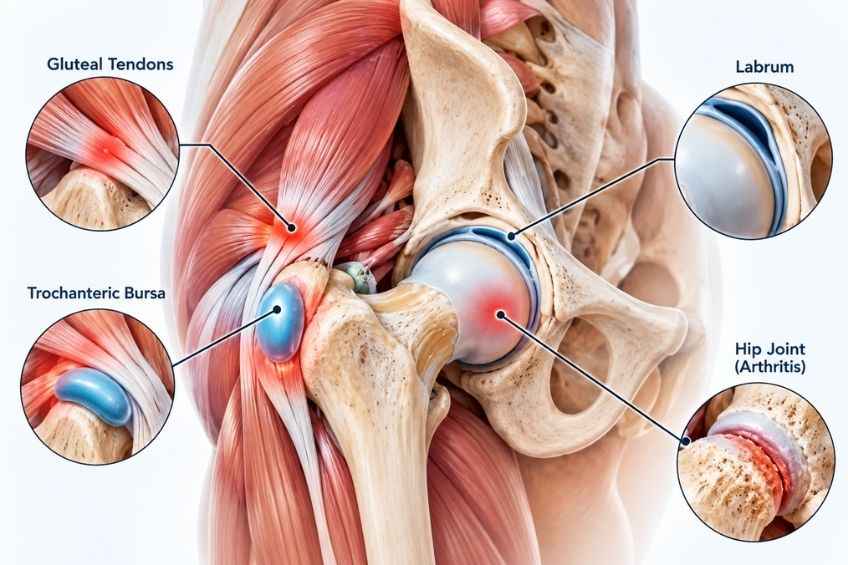
The goal is not simply to quiet pain for a few weeks. The goal is to help you walk better, protect the joint, rebuild strength, and decide whether a non-surgical hip restoration plan is appropriate for you.
Shoulder Pain And Conditions | Elbow, Wrist And Hand Conditions | Foot And Ankle Conditions
Let's build your path to recovery - together.

Advanced regenerative care for lasting results.
ANEW Regenerative Medicine Specialists
28544 Orchard Lake Rd,
Farmington Hills, MI 48334
Tel: 248-861-2639
Email: care@anewregen.com